Motor oil has to meet diverse requirements. When fuel is burned in an engine, temperatures of over 2000°C are generated under high pressures. Dirt particles and soot get into the oil circulation system. Oil filter media must remove these contaminants and store them and do so at high temperatures, despite oils containing high volumes of additives.
Ever-reducing space under the hood, reduced oil volumes, longer service intervals and higher efficiency requirements continuously present ever higher demands on filter materials and how they are combined.
Depending on customer requirements, cellulose, synthetic or glass fibres are used in our filter media. This spans from media containing only cellulose to media made from 100% synthetic fibres and anything in between, and from media consisting of just one layer to those with many. Resin impregnations optimized for oil filtration significantly improve resistance to hot oil, while keeping the media stiff and stable.
We offer a wide variety of grades to meet individual process and filter requirements: 100% cellulose, combinations made of cellulose, glass, and synthetic fibers or layered media. GESSNER is able to tailor the media onto your special requirements, from a highly efficient filter media, also as corrugated grades available, which increase filter lifetime to its optimum.
GESSNER's filter media solution made of 100% cellulose media are saturated with phenolic resins, making them more durable and long-lasting than other standard filter media solutions. Highly developed media with our gradient structure improve depth filtration thanks to their media structure and composition.
As we know that every application has special requirements, we also offer our grades in corrugated form to meet a wide range of customer requirements. The corrugated media structure stabilizes the pleats, preventing them from collapsing and thus increasing the filter efficiency. With this option, we provide greater flexibility and choice, ensuring that our customers can find the ideal solution for their specific needs.
For those looking for a sustainable filter media, we offer FSC® certified grades of our cellulose filter paper, sourced from responsibly managed forests. To reduce your product carbon footprint, we have developed a lignin-saturated cellulose filter media available.
GESSNER also offers filter solutions that combine a cellulose media with synthetic and/or glass fibers to achieve the best possible filtration performance. They are designed to achieve even higher efficiencies due to their media structure.
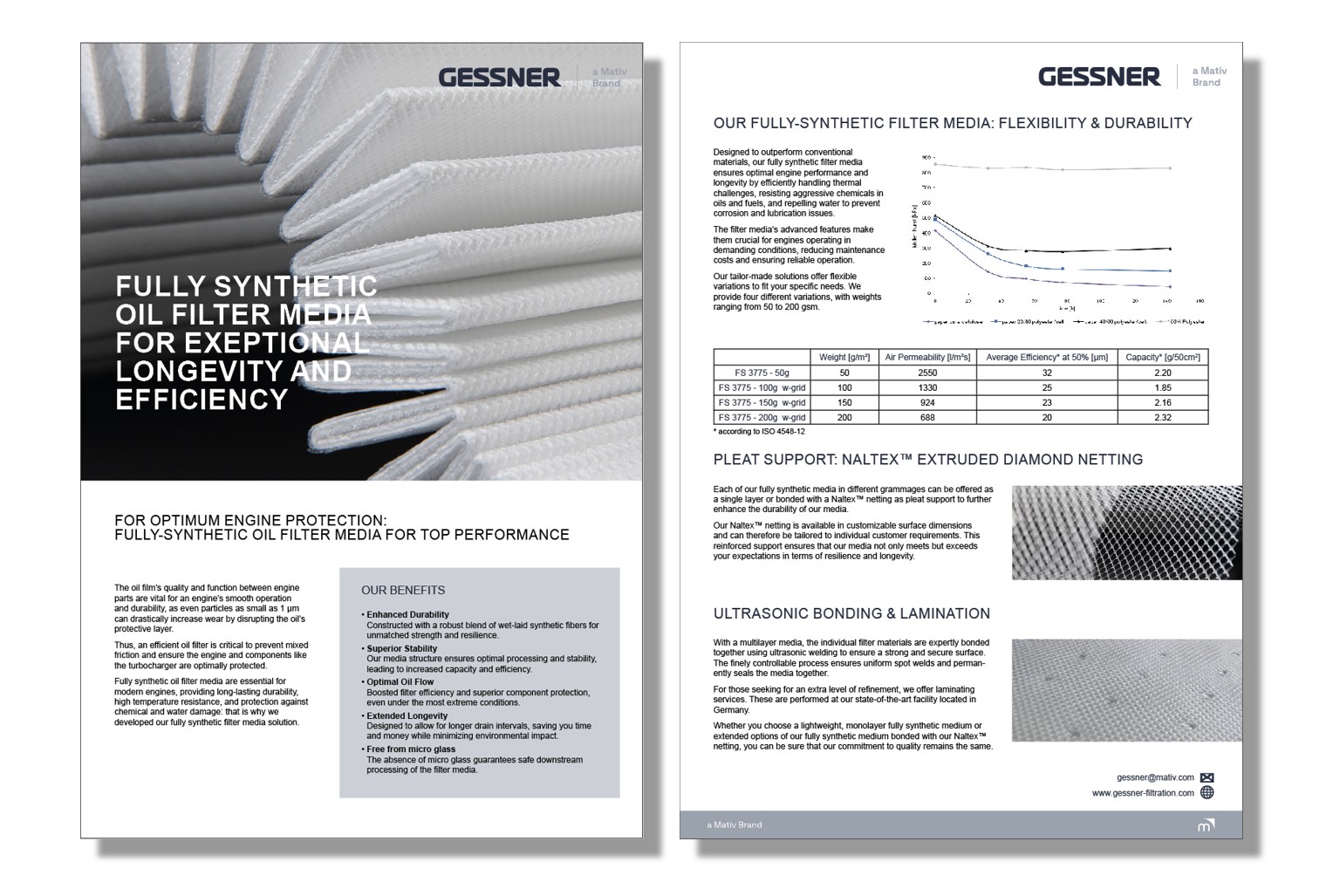
GESSNER's fully synthetic oil filter media is composed of wet-laid synthetic fibers, which can be reinforced with a Naltex™ netting for additional pleat support. This media structure ensures better processing and superior stability due to the media composition, which provides improved capacity and efficiency and allows for longer drain intervals. In addition, our fully synthetic oil filter media provides improved oil flow which not only results in increased filter efficiency but also ensures optimized component protection even under extreme conditions.
Naltex™ extruded netting is a pleat support material used in oil filter elements, helping to protect and extend their lifespan, especially when using synthetic filter medias. It provides structural support to the lengthwise folds of synthetic media, allowing for more pleats per inch while increasing air flow. This pleat support works by extending the filter's ability to capture more dirt and particles, leading to a more efficient filtration process. Naltex™ netting is specifically designed to be lightweight, yet strong and durable for the toughest of environments.


GESSNER’s oil filter media are engineered to excel under extreme conditions, including high engine temperatures and exposure to chemical additives. The media can withstand hot oil conditions and harsh chemicals without breaking down. This is achieved by enhancing the filter material with polyester fibers and special resin coatings: polyester-reinforced grades provide heat stability, and phenolic/epoxy resin impregnation protects the fibers from thermal and chemical attack.
As a result, the filter media remain structurally stable and effective at filtering even when oil temperatures are very high or the oil contains corrosive contaminants. In practical terms, this means the filter will continue to do its job in the toughest engine environments, making it highly reliable for both automotive and industrial applications.
Using GESSNER’s filter media can yield cost savings over the lifecycle of equipment. The key is their combination of high efficiency and high dirt-holding capacity, which extends the useful life of each filter. Because the media can hold more contaminants before clogging (thanks to gradient density layers, etc.), filters don’t need to be changed as often. Longer service intervals directly translate to reduced maintenance costs – less frequent oil filter replacements mean spending less on filters and labor over time.
Moreover, keeping the oil cleaner protects engine components from wear, potentially avoiding costly repairs or premature engine overhauls. Studies show that improved filtration can lengthen engine life by reducing abrasive wear; in essence, an efficient filter media is an investment in equipment longevity.
For industrial users, fewer filter changeouts mean less downtime, which is financially beneficial as well. All these factors contribute to a lower TCO. While a high-performance filter media might have a slightly higher upfront cost than a basic filter, it pays back by lasting longer and safeguarding expensive equipment. In summary, GESSNER’s oil filter media help reduce the total cost of ownership through extended filter life, fewer change intervals, and better engine protection, which together drive down maintenance and operational expenses over time.
Yes – GESSNER’s oil filter media are designed for easy integration into standard filter production processes, and the company offers plenty of technical support and format options.
The media is supplied in continuous rolls at specified widths and lengths, suitable for conventional pleating machines used by filter manufacturers.
GESSNER ensures the media has consistent caliper (thickness), basis weight, and resin impregnation, so that it pleats uniformly without variation.
In fact, they have in-line quality controls like optical inspection and permeability measurements to guarantee each batch of media runs smoothly on customer equipment.
For customers, GESSNER can provide the media either flat or pre-corrugated.
Moreover, GESSNER can supply “multilayer” media constructions or add-ons: for instance, bonding a Naltex™ extruded net to the media as a pleat support layer. (Naltex is a plastic mesh that reinforces the filter pleats, preventing collapse and adding durability, often used in high-performance or synthetic filters.) This means filter OEMs can get a ready-to-use composite that already includes support mesh, eliminating an assembly step on their end.
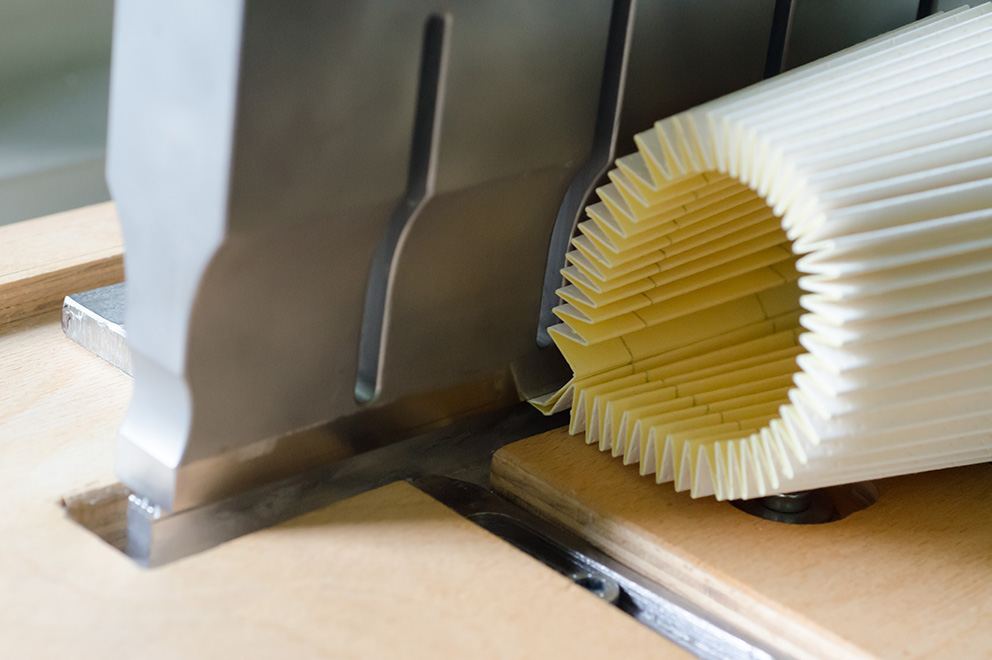
GESSNER also offers ultrasonic welding and lamination services for those who need multiple layers (e.g. a cellulose layer plus a synthetic layer bonded together) – delivered as one unified media roll.
Integration guidance is part of GESSNER’s customer support: their engineers can work with OEMs to tailor the media to specific requirements (dimensions, pleat counts, resin type for compatibility, etc.). They ensure that the media will meet the needed specifications (for example, if an OEM filter design calls for a certain pressure drop and efficiency, GESSNER will recommend the appropriate media grade).
Many filter manufacturers have already qualified GESSNER’s media in their production, so the materials are proven on typical equipment. In summary, GESSNER makes it straightforward to adopt their media by providing it in convenient formats (rolls, corrugated, with supports) and guaranteeing high, consistent quality.
Filter producers can expect trouble-free pleating, curing, and assembly with GESSNER media, and they have the option to receive custom adaptations (like added reinforcement or special treatments) to best fit their product. This flexibility and support help OEMs quickly integrate the media and bring a superior filter to market with minimal process changes
GESSNER places a strong emphasis on sustainability in its filter media line, beyond just offering FSC®-certified filter paper. (FSC certification means the cellulose comes from responsibly managed forests, which GESSNER does provide.) In addition, the company has been innovating to reduce the environmental footprint of its products and manufacturing. For example, GESSNER is exploring bio-based resin binders as alternatives to traditional phenolic resins. A recent development involves using lignin, a natural polymer from wood, as a binding agent – this can significantly cut the product’s carbon footprint while maintaining performance. Likewise, some filter media versions use recycled fibers or polymers where possible, and the company continuously works to improve energy efficiency in production (evidenced by ISO 50001 energy management certification of its facilities).
From an end-of-life perspective, GESSNER’s oil filter media are fully incinerable, containing no heavy metals or hazardous components. This means used filter elements can be safely burned (for energy recovery) as is common in oil filter disposal, without harmful residue. Moreover, the media’s long service life contributes to sustainability by reducing the number of filter replacements and thus waste generated over an engine’s life. GESSNER also minimizes use of formaldehyde in its resins and follows strict environmental regulations (ISO 14001-certified operations) to ensure eco-friendly processes. In short, customers concerned with “green” aspects can be confident that GESSNER’s solutions not only deliver high performance but also support sustainability – through responsibly sourced materials, longer-lasting filters (less waste), and new eco-conscious innovations like lignin-based filter media.
Polyester-reinforced grades refer to filter media that include a layer or blend of polyester fibers to strengthen the media.
Polyester is a synthetic fiber known for its toughness and thermal stability. By integrating polyester into the filter paper, the media becomes more heat-resistant. This reinforcement prevents the media from warping or disintegrating at high temperatures where a standard cellulose filter might weaken. Additionally, polyester has good chemical resistance, so it helps the filter media resist oil additives and acidic byproducts in the oil.
In short, polyester-reinforced media are used to ensure the filter remains intact and efficient in high-temperature, chemically aggressive conditions that occur in modern engines.
Phenolic and epoxy resins are used to saturate or bond the fibers of the filter media (especially cellulose fibers), essentially acting as a glue that hardens and gives the media structure.
Their role is to increase the media’s durability and heat/chemical resistance. When the filter paper is impregnated with these resins and cured, it becomes stiffer and more stable – it won’t soften or deteriorate when soaked in hot oil.
Phenolic resins, in particular, are known for providing excellent thermal stability, meaning the filter can handle prolonged exposure to high temperatures without losing strength.
Epoxy resins add chemical resistance and structural integrity.
Together, these resin treatments ensure the filter media holds up in harsh and corrosive environments, maintaining performance instead of breaking down.
Essentially, the resins make the filter media tougher and longer-lasting under extreme conditions.
In oil filtration, high efficiency means the filter media can remove a very large percentage of contaminants from the oil, including extremely fine particles. GESSNER’s oil filter media are designed for high filtration efficiency - they trap more dirt and soot per pass of oil. This is accomplished by using finer fibers in the media.
In fact, GESSNER has significantly increased the efficiency of its oil filter products by incorporating low-diameter polyester fibers and micro glass fibers into the paper. These very fine fibers create a tighter mesh that snags smaller particles that might pass through a conventional filter.
The result is that the oil coming out of the filter is cleaner. High efficiency is crucial because it means better protection for engine components (less abrasive debris circulating) and it helps the engine maintain performance over time.
In summary, “high efficiency” indicates that the filter media does an excellent job of cleaning the oil, capturing the vast majority of contaminants on each flow through the filter.
Thinner fibers like fine polyester and micro-glass essentially make the filter media more efficient by creating a denser network to capture particles. Because these fibers are very small in diameter, the gaps (pores) between fibers in the media are smaller, which means even tiny particles get caught instead of passing through.
The micro glass fibers, in particular, are extremely fine and can capture microscopic soot and wear particles. By mixing these fibers into the media, GESSNER increases the surface area and depth available for filtration. More fibers and smaller pores lead to higher particle interception without requiring a thicker filter. This design boosts the filtration efficiency significantly.
Importantly, the fiber blend is optimized so that oil can still flow sufficiently (addressed further below), but the key point is that these low-diameter fibers enable the filter to screen out more contaminants from the oil on each cycle, elevating overall filtration performance.
Dust Holding Capacity (DHC) is the term for how much contamination a filter media can hold before it becomes clogged or needs to be replaced. In the context of oil filters, “dust” refers broadly to any particles in the oil – dirt, soot, metal wear particles, etc. A high DHC means the filter media can accumulate a large amount of these particles over time without losing effectiveness.
This is beneficial because the higher the capacity, the longer the filter can go before it fills up and needs changing. In other words, a filter with high DHC has an extended usable life. For the customer, this translates to longer service intervals – you don’t have to replace the filter as frequently.
A high DHC filter saves on maintenance costs and is convenient, especially in industrial or heavy-duty applications where changing filters often can be labor-intensive or require downtime. It also means that even towards the end of a long service interval, the filter is still capable of holding more dirt, providing reliable filtration throughout its life.
So, high DHC is essentially about filter longevity and efficiency over time, ensuring consistent oil cleanliness and reducing how often maintenance is needed.
Yes. GESSNER’s oil filter media are designed to be versatile and robust, making them suitable for a wide range of applications in both the automotive and industrial sectors. The same filter media technology that keeps car and truck engines protected can also be applied to industrial machinery and equipment.
The key features – high temp resistance, chemical resistance, high efficiency, and high dirt capacity – are beneficial in any oil filtration scenario. The media’s robust construction ensures it performs reliably in automotive engines (which face high temperatures and RPMs) as well as in industrial systems (which may run continuously or deal with heavy contamination).
Our oil filter media, reinforced and resin-treated, offer “unparalleled durability” in a variety of automotive and industrial applications. So whether you need filters for passenger vehicles, trucks, construction machinery, or manufacturing equipment, the GESSNER media can meet the performance demands.
GESSNER provides a range of filter media compositions to suit different requirements. The main oil filter media grades include:
In addition to the filter papers themselves, GESSNER can supply Naltex™ pleat support netting as part of the solution. Naltex is a plastic mesh that doesn’t filter but is used to support and stabilize filter pleats, often paired with synthetic media to handle higher flow or more pleats. This accessory ensures the filter element maintains its shape and capacity. With these options, GESSNER can cover everything from standard oil filters to those requiring advanced performance (for example, filters that must handle very long service intervals or particularly dirty environments).
Absolutely. One of GESSNER’s strengths is its ability to provide tailor-made filter media solutions for customers.
We can customize the media’s formulation and construction to meet specific performance targets. For instance, if a customer needs even higher efficiency or capacity, GESSNER can adjust the fiber blend (the ratio of cellulose, synthetic, glass fibers) and the basis weight (thickness) of the media accordingly. They can also alter the resin impregnation levels to tweak stiffness or resistance.
Additionally, the media can be made in multiple layers or provided in a corrugated (wavy) form if the application calls for it. Corrugation is often used to increase support and prevent pleat collapse, which is something GESSNER offers to ensure filter integrity under high flow rates. Essentially, GESSNER works with clients to fine-tune the filter media design – whether it’s increasing heat resistance, adding more dust capacity, or improving flow characteristics – so that the final product is optimally suited to the intended engine or machine.
This customization ensures that each customer gets a filtration solution that delivers the highest performance under their specific operating conditions.